Introduction to Salt and Alkaline Stress in Wheat
Soil salinity and alkalinity are major environmental constraints that reduce agricultural productivity worldwide, especially in arid and semi-arid regions. Excessive salt accumulation in soil negatively affects plant growth, crop yield, nutrient uptake, and physiological metabolism. In many agricultural areas, soil salinization and alkalization occur simultaneously, creating severe limitations for sustainable crop production.
Alkaline soils are particularly harmful because they expose plants not only to osmotic stress and ion toxicity but also to high pH stress. Neutral salts such as sodium chloride (NaCl) and sodium sulfate (Na2SO4) mainly cause ionic imbalance and osmotic pressure, whereas alkaline salts including sodium bicarbonate (NaHCO3) and sodium carbonate (Na2CO3) additionally disrupt cellular pH homeostasis. High soil pH damages membrane stability, nutrient absorption, enzyme activity, and metabolic processes, making alkaline stress more destructive than salt stress alone.
Improving salt-alkali tolerance in crops has therefore become an important objective in modern agricultural and plant physiology research.
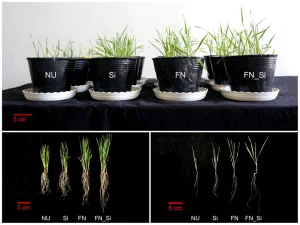
Wheat Sensitivity to Salinity and Alkalinity
Wheat is one of the most important cereal crops globally and serves as a primary food source for millions of people. However, wheat productivity is highly affected by salinity and alkaline soil conditions.
Salt and alkaline stresses inhibit:
- Seed germination
- Root development
- Shoot growth
- Photosynthesis
- Nutrient transport
- Water absorption
- Biomass accumulation
Previous studies have investigated mechanisms associated with salt tolerance in wheat, especially under NaCl stress conditions. However, research related to alkaline stress tolerance remains limited, particularly regarding the physiological mechanisms that allow wheat seedlings to adapt to high-pH environments.
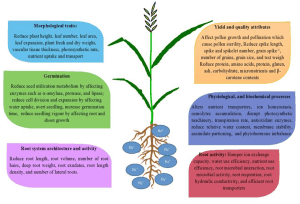
Role of Abscisic Acid in Plant Stress Tolerance
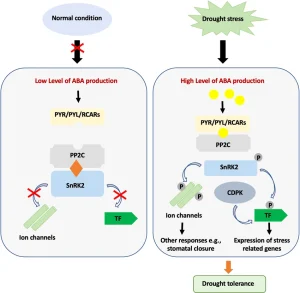
Abscisic Acid (ABA) is a plant hormone that plays a central role in stress signaling and environmental adaptation. ABA functions as an important regulator of plant responses to abiotic stresses such as:
- Salinity
- Drought
- Osmotic stress
- Cold stress
- Water deficiency
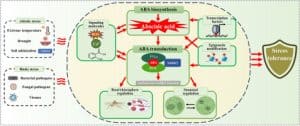
Under stressful environmental conditions, endogenous ABA concentrations rapidly increase within plant tissues. This hormone activates several protective mechanisms that improve stress tolerance and cellular stability.
ABA regulates plant adaptation through multiple physiological processes, including:
- Stomatal closure regulation
- Ion transport adjustment
- Osmotic balance maintenance
- Stress-responsive gene expression
- Antioxidant defense activation
- Water conservation mechanisms
Previous studies demonstrated that ABA pretreatment can reduce the harmful effects of NaCl stress by improving plant growth and regulating ion distribution. However, the role of exogenous ABA application in alleviating alkaline stress in wheat remained poorly understood.
Experimental Design and Wheat Seedling Treatments
A controlled pot experiment was conducted using a salt-tolerant wheat cultivar, Jimai 3 Wheat. Wheat seedlings were grown in washed sand under outdoor conditions and supplied daily with Hoagland nutrient solution before stress treatments.
Two stress conditions were applied:
Salt Stress Treatment
Neutral salt solution containing:
- NaCl
- Na2SO4
Alkaline Stress Treatment
Alkaline salt solution containing:
- NaHCO3
- Na2CO3
The alkaline treatment produced a significantly higher pH compared to salt stress conditions.
Two concentrations of exogenous ABA were tested:
- 50 μmol/L ABA
- 100 μmol/L ABA
ABA solution was sprayed directly onto wheat leaves during the stress treatment period to evaluate its effects on plant growth, ion regulation, and metabolic responses.
Effects of Salt and Alkaline Stress on Wheat Biomass
Both salt stress and alkaline stress significantly inhibited wheat seedling growth. However, alkaline stress caused much stronger damage than neutral salt stress.
Major reductions were observed in:
- Shoot dry weight
- Root dry weight
- Overall seedling biomass
Alkaline stress severely suppressed root growth and accelerated leaf yellowing and wilting due to combined ionic toxicity and high-pH damage.
Application of low-concentration ABA (50 μmol/L) significantly improved shoot biomass under both stress conditions, particularly during alkaline stress. The beneficial effects of ABA were more evident in shoots because the hormone was applied directly to leaf tissues.
In contrast, high ABA concentration (100 μmol/L) showed weaker protective effects, indicating that moderate ABA levels are more effective for improving wheat stress tolerance.
Regulation of Inorganic Ions Under Stress Conditions
Salt and alkaline stresses disrupted ion balance in wheat seedlings by increasing toxic sodium accumulation and reducing essential mineral uptake.
Sodium Accumulation Under Salt Stress
Under salt stress:
- Na+ levels increased significantly in shoots and roots
- K+ levels decreased
- Cl− accumulation increased
- Nutrient balance was disrupted
Excessive sodium accumulation is toxic because it damages membranes, enzymes, and cellular metabolism.
More Severe Ionic Toxicity Under Alkaline Stress
Alkaline stress caused even stronger Na+ accumulation than salt stress. High external pH enhanced sodium transport into shoot tissues while restricting the absorption of essential anions such as:
- NO3−
- H2PO4−
This imbalance severely affected nutrient homeostasis and physiological stability.
ABA Reduces Sodium and Chloride Toxicity
Exogenous ABA application significantly reduced Na+ and Cl− accumulation in wheat shoots under both stress conditions.
Under salt stress, ABA:
- Lowered sodium accumulation in shoots
- Reduced chloride toxicity
- Improved ionic balance
- Maintained better K+/Na+ ratios
Under alkaline stress, ABA substantially decreased sodium accumulation in shoot tissues, thereby alleviating ion toxicity and reducing pH-induced cellular damage.
These results suggest that ABA regulates ion transport systems involved in sodium exclusion and shoot ion homeostasis.
Organic Solutes and Osmotic Adjustment
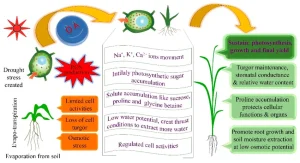
Plants accumulate organic solutes under stress conditions to maintain osmotic balance and protect cellular structures.
Proline Accumulation
Proline is an important stress-associated amino acid that accumulates during salt and alkaline stress.
Under stress conditions:
- Proline concentration increased significantly
- Shoot tissues accumulated more proline than roots
- Proline acted as an osmotic adjustment compound
However, ABA treatment reduced proline accumulation under alkaline stress, suggesting that exogenous ABA alleviated stress severity and reduced the need for excessive proline synthesis.
Soluble Sugar Accumulation
Salt and alkaline stress also stimulated soluble sugar accumulation in wheat seedlings. Soluble sugars play essential roles in:
- Osmotic regulation
- Membrane stabilization
- Energy metabolism
- Stress protection
Interestingly, ABA treatment further enhanced soluble sugar synthesis under alkaline stress. Increased soluble sugar accumulation improved osmotic adjustment capacity and contributed to better stress resistance.
Organic Acid Metabolism
Under alkaline stress, wheat seedlings accumulated high levels of organic acids to balance excess sodium ions and stabilize intracellular pH.
Major organic acids included:
- Citric acid
- Malic acid
- Oxalic acid
- Succinic acid
- Acetic acid
ABA application reduced organic acid accumulation, indicating that ABA alleviated high-pH stress and improved cellular ion balance.
Physiological Mechanisms of ABA-Mediated Stress Tolerance
The protective role of ABA in wheat seedlings involves several interconnected physiological mechanisms.
ABA-Mediated Salt Stress Tolerance
Under salt stress, ABA mainly:
- Reduced Na+ and Cl− toxicity
- Improved ion homeostasis
- Limited sodium transport to shoots
- Enhanced osmotic regulation
ABA-Mediated Alkaline Stress Tolerance
Under alkaline stress, ABA additionally:
- Reduced pH stress
- Decreased organic acid accumulation
- Enhanced soluble sugar synthesis
- Improved osmotic adjustment
- Protected shoot growth
The study demonstrated that alkaline stress causes more severe physiological damage than neutral salt stress because of the combined effects of ion toxicity and high pH.
Importance of ABA Concentration and Application Method
The effectiveness of ABA depended strongly on:
- Hormone concentration
- Application site
- Stress severity
Foliar application mainly improved shoot physiology because ABA directly influenced leaf tissues involved in photosynthesis, transpiration, and ion regulation.
Lower ABA concentration (50 μmol/L) produced better protective effects than higher concentration (100 μmol/L), indicating that excessive ABA application may reduce physiological efficiency.
Conclusion
Exogenous Abscisic Acid significantly alleviates the harmful effects of salt and alkaline stress in wheat seedlings by regulating ion balance, osmotic adjustment, and metabolic responses.
Protective effects of ABA include:
- Reduction of sodium and chloride toxicity
- Improvement of shoot biomass
- Enhancement of soluble sugar accumulation
- Reduction of pH-induced stress
- Regulation of organic acid metabolism
- Improvement of osmotic adjustment capacity
The study also confirmed that alkaline stress is more damaging than salt stress due to the combined effects of ionic toxicity and high pH conditions.
Among the tested treatments, low ABA concentration (50 μmol/L) showed the greatest effectiveness in improving wheat salt-alkali tolerance, suggesting its potential application in agricultural management strategies for saline and alkaline soils.