Wild Potato Classification and Geographic Distribution
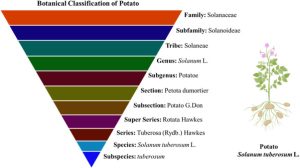
The genus Solanum represents one of the largest and most genetically diverse groups within flowering plants, comprising approximately 1,000 to 2,000 species according to different botanical classifications. Most members of this genus are herbaceous or shrubby plants, frequently characterized by spines or thorn-like structures, while only a limited proportion develop underground tubers.
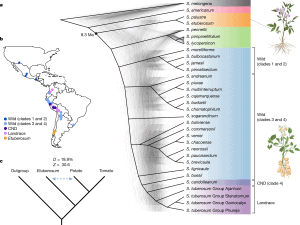
Wild potato species are naturally distributed throughout the American continent, extending from the southeastern regions of the United States to southern Chile and eastern South America, including Argentina, Paraguay, Uruguay, and Brazil. The principal centers of genetic diversity are located in central Mexico and across the Andean highlands from Peru to northwestern Argentina. These regions contain highly diverse ecological niches that have promoted the evolution of numerous genetically distinct potato populations.
Wild potato species display remarkable cytogenetic diversity through multiple ploidy levels, including diploid, triploid, tetraploid, pentaploid, and hexaploid forms. Their chromosome organization is based on a common chromosome number of x = 12, allowing the development of complex genomic structures and evolutionary adaptations to contrasting environmental conditions such as altitude, temperature, humidity, and soil composition.
Reproductive Biology and Breeding Systems in Wild Potatoes
Wild potatoes reproduce through both sexual and asexual mechanisms, which significantly contributes to their evolutionary success and genetic variability.
Sexual Reproduction and Genetic Diversity
Sexual reproduction occurs through seed formation and promotes meiotic recombination and fertilization, generating new genetic combinations that may enhance adaptation to changing environmental conditions. This mechanism plays a critical role in maintaining long-term evolutionary flexibility within natural potato populations.
Asexual Reproduction and Clonal Stability
Asexual propagation occurs through stolons and tubers, enabling genetically stable and environmentally adapted genotypes to persist over time. Clonal reproduction allows wild potato populations to preserve advantageous traits without depending entirely on seed fertility.
Self-Incompatibility Mechanisms in Wild Potato Species
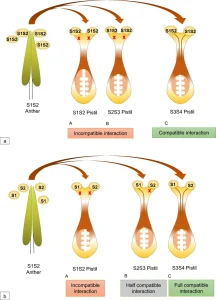
Most diploid wild potato species possess a strong gametophytic self-incompatibility system regulated by the multiallelic S-locus. This biological mechanism prevents self-fertilization and promotes cross-pollination between genetically distinct individuals, increasing population heterozygosity and genetic diversity.
In polyploid species, interactions among multiple S-alleles can reduce incompatibility responses, permitting partial self-compatibility and hybrid formation. This process, known as competition interaction, facilitates hybridization events and contributes to extensive gene flow among wild potato populations.
Cytogenetics and Genome Evolution in Potato Species
Cytogenetic studies have demonstrated that wild potato species share a common ancestral A genome. Through progressive genomic modifications, additional genomic groups designated B, C, D, and E evolved over time. Despite differences in chromosome number and ploidy level, most potato species remain phylogenetically related.
This genomic similarity explains why interspecific hybridization frequently occurs between wild potato taxa, often producing vigorous and fertile hybrids capable of further introgression into natural populations.
Hybridization Barriers in Wild Potato Populations
Wild potato species are separated by both external and internal reproductive barriers.
External Isolation Mechanisms
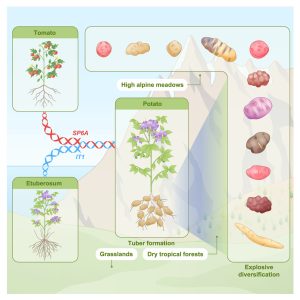
Geographical separation, ecological specialization, and environmental adaptation limit hybridization between distant populations. However, overlapping habitats frequently allow sympatric species to coexist and exchange genetic material.
Internal Reproductive Barriers
Internal breeding barriers are classified into two major categories:
- Pre-zygotic barriers: These occur before fertilization and involve incompatibility reactions between pollen and pistil tissues.
- Post-zygotic barriers: These occur after fertilization and mainly affect embryo and endosperm development.
Pre-zygotic incompatibility may act unilaterally or bilaterally and is controlled by complex genetic systems independent of the classical S-locus.
Endosperm Balance Number Theory in Potato Hybridization
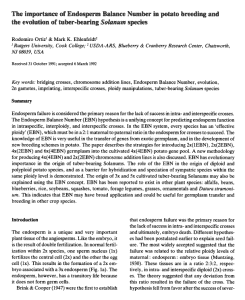
One of the most important mechanisms regulating potato hybridization is the Endosperm Balance Number Theory. According to this theory, successful seed development depends not only on chromosome number but also on an effective genetic dosage called the Endosperm Balance Number (EBN).
For proper endosperm formation, a two-to-one maternal-to-paternal EBN ratio is required. Species with incompatible EBN values often fail to produce viable seeds due to abnormal endosperm development.
Nevertheless, certain mechanisms such as the formation of unreduced 2n gametes can bypass these barriers, enabling hybridization between otherwise incompatible species.
Natural Hybridization and Introgression in Wild Potatoes
Incomplete reproductive isolation in wild potato populations creates ideal conditions for spontaneous hybridization, introgression, and gene flow. Natural populations may therefore contain:
- Pure parental genotypes
- First-generation hybrids
- Advanced segregating hybrids
- Backcross populations
- Introgressed forms
These complex genetic interactions generate highly variable populations that challenge traditional taxonomic classification systems.
Hybridization events are especially common in sympatric populations where different species coexist geographically. Because genomic differentiation between species is often limited, fertile hybrids can persist and contribute to long-term evolutionary diversification.
Germplasm Banks and Potato Genetic Conservation
Wild potato accessions are conserved in specialized germplasm banks for breeding, research, and biodiversity preservation purposes. These collections represent samples of natural populations maintained either as seeds, tubers, or in vitro plant materials.
Importance of Potato Germplasm Collections
Potato germplasm repositories play a critical role in preserving genetic diversity for:
- Disease resistance breeding
- Abiotic stress tolerance
- Crop improvement programs
- Evolutionary and taxonomic research
Passport data associated with germplasm accessions commonly include:
- Geographic coordinates
- Collection site
- Altitude
- Date of collection
However, detailed information regarding population structure, sampling strategy, effective population size, and genetic drift is often incomplete or unavailable. Consequently, ex situ collections may not always accurately represent the original genetic diversity present in natural populations.
Species Concepts and Potato Taxonomy
Taxonomic Species Concept
Traditional potato classification relied heavily on morphological characteristics. Under this system, species were defined according to visible traits and represented by type specimens or holotypes.
Biological Species Concept
Modern evolutionary biology introduced the Biological Species Concept, which defines species as reproductively isolated populations capable of interbreeding naturally.
However, wild potatoes frequently violate strict reproductive isolation criteria due to extensive hybridization, introgression, polyploidy, and mixed reproductive systems. As a result, species boundaries within potato populations remain highly complex and controversial.
Evolution of Potato Taxonomy
Early potato taxonomists described numerous species based primarily on morphological variation observed in herbarium specimens. This approach resulted in excessive taxonomic fragmentation because minor phenotypic differences were often interpreted as distinct taxa.
Later researchers recognized the strong influence of environmental conditions and phenotypic plasticity on potato morphology. Consequently, broader species concepts were proposed to better reflect biological and genetic relationships.
Modern molecular studies using:
- RAPD markers
- AFLP analysis
- Chloroplast DNA sequencing
- Nuclear DNA markers
- SSR markers
have revealed extensive overlap among many previously recognized species.
Several researchers concluded that hybridization, gene flow, polyploidy, and recent evolutionary divergence contribute to the difficulty of establishing clear phylogenetic relationships within potato species complexes.
Molecular Tools and Modern Taxonomic Challenges
Advances in molecular genetics and bioinformatics have transformed the study of wild potato diversity. Molecular analyses have demonstrated that many potato species previously classified as separate taxa are genetically interconnected.
Nevertheless, molecular approaches also face important limitations:
- Small sample sizes
- Limited marker coverage
- High within-population variability
- DNA pooling artifacts
- Incomplete representation of natural populations
Studies frequently show greater genetic variation within accessions than between accessions, emphasizing the dynamic and heterogeneous nature of wild potato populations.
Hybridization as an Evolutionary Force
Natural hybridization is now recognized as a major evolutionary mechanism in wild potato diversification. Hybrid zones allow the exchange of adaptive genes between populations and may facilitate ecological expansion into disturbed or changing environments.
In many cases, hybrid populations exhibit high fertility, genetic flexibility, and enhanced environmental adaptation. These findings support the idea that wild potatoes represent a continuously evolving genetic network rather than strictly isolated biological entities.
Final Perspective on the Wild Potato Species Problem
The taxonomic classification of wild potatoes remains one of the most complex challenges in plant evolutionary biology. The coexistence of:
- Sexual and asexual reproduction
- Polyploidy
- Hybridization
- Introgression
- Incomplete reproductive barriers
- High phenotypic plasticity
- Environmental adaptation
creates highly dynamic population systems that cannot be fully explained using traditional classification models alone.
Future research in potato systematics will increasingly depend on integrative approaches combining:
- Molecular genetics
- Cytogenetics
- Population biology
- Ecology
- Reproductive biology
- Evolutionary genomics
- Advanced statistical modeling
A comprehensive systems-based approach will provide more accurate insights into species boundaries, evolutionary relationships, and genetic diversity in wild potato populations.