
Introduction
Lilium ledebourii (Baker) Boiss., known locally in Iran as “Susan-e-chelcheragh”, is a rare and endangered lily species belonging to the family Liliaceae. It is the only threatened Lilium species naturally found in Iran, making it a high-priority plant for conservation.
This species is also highly valued for ornamental horticulture because it produces large, elegant white flowers that are comparable in beauty to commercial lily varieties. Each plant typically produces 4 to 10 flowers, although some individuals can produce up to 15 flowers under favorable conditions.
In nature, L. ledebourii is restricted to a very small geographic area on the eastern slopes of the Alborz Mountains, especially around Damash village in northern Iran, at elevations between 1,700 and 1,900 meters. Unfortunately, its natural habitat is shrinking due to overgrazing, human disturbance, and illegal harvesting, which puts wild populations at serious risk.
Because of these threats, traditional conservation methods alone are not enough. In vitro propagation techniques are needed to preserve and multiply this endangered species in a controlled environment.
Why Micropropagation is Needed
The propagation of Lilium ledebourii through conventional methods is very limited due to:
- Low seed production
- Slow natural reproduction rate
- Difficulty in vegetative multiplication
These biological limitations make large-scale cultivation nearly impossible using traditional approaches.
For this reason, plant biotechnology offers an effective solution. Among the available techniques, somatic embryogenesis (SE) is one of the most powerful methods for rapid plant multiplication and conservation.
What is Somatic Embryogenesis?
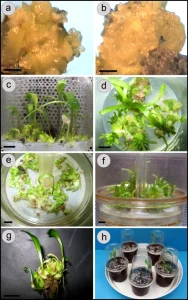
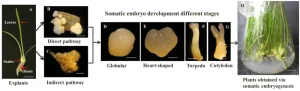
Somatic embryogenesis is a plant tissue culture technique where whole plants are regenerated from somatic (non-reproductive) cells. This method is widely used in plant biotechnology because it allows fast and efficient plant production under laboratory conditions.
Compared to traditional regeneration methods like organogenesis, somatic embryogenesis offers several key advantages:
- Formation of complete plant structures (shoot + root system) in a single step
- Very high multiplication rate from small tissue samples
- Reduced need for repeated regeneration steps
- Possibility of long-term storage (cryopreservation)
- Use in genetic improvement and transformation studies
- Production of synthetic seeds for large-scale planting
Because of these benefits, SE is widely used for both plant conservation and commercial micropropagation.
Previous Work on Lily Tissue Culture
Somatic embryogenesis has already been successfully achieved in several lily species such as Lilium longiflorum and different hybrid lilies. In most studies, bulb scales and other plant tissues were used as starting material.
However, using bulb tissues has several drawbacks:
- High risk of bacterial and fungal contamination
- Destruction of the donor plant (important issue for endangered species)
- Limited efficiency for mass propagation
To overcome these problems, researchers have developed the Thin Cell Layer (TCL) technique, which uses very small and carefully selected plant tissue slices. This method reduces damage to the plant and improves regeneration efficiency.
TCL-based regeneration has already shown strong success in different Lilium species and has become an important tool in modern plant tissue culture.
Aim of This Study
This research focuses on developing an efficient in vitro regeneration system for Lilium ledebourii using the TCL approach.
The main goals of the study were:
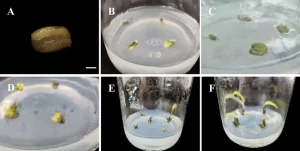
- To use bulblet thin cell layer (tTCL) explants derived from in vitro bulb scales
- To test different plant tissues, including bulblet microscales and young roots
- To evaluate the effect of plant growth regulators on callus and embryo formation
- To induce somatic embryogenesis and regenerate whole plants
- To improve propagation efficiency for conservation purposes
Why This Research Matters
This study provides an effective micropropagation strategy for Lilium ledebourii, an endangered ornamental plant with limited natural regeneration ability. The developed protocol can be used for:
- Conservation of wild populations
- Large-scale clonal propagation
- Germplasm preservation
- Future breeding and genetic improvement programs
Overall, somatic embryogenesis offers a reliable biotechnological solution to protect and sustainably propagate this rare Iranian lily species.