Introduction to Rice Grain Length and Quality Traits
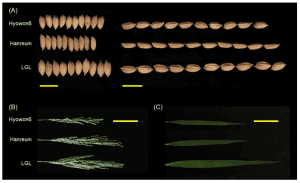
Rice grain length and grain shape are major quality traits that strongly influence the commercial value and consumer acceptance of rice varieties. These characteristics affect grain appearance, milling efficiency, cooking performance, and eating quality, making them essential targets in modern rice breeding programs. Different regions and markets prefer different grain types. Long and slender rice grains are highly demanded in countries such as China, India, Pakistan, Thailand, and the United States, while short-grain rice varieties are preferred in Japan and Sri Lanka.
Grain size is also an important evolutionary and domestication trait in cereal crops. During crop domestication, humans generally selected plants with larger seeds because they provided better yield and improved food value. In contrast, natural selection often favors smaller seeds because they are associated with earlier maturity, higher seed number per plant, and broader environmental adaptation. For these reasons, understanding the genetic mechanisms controlling rice grain length is highly important for both crop evolution studies and rice quality improvement.
Quantitative Inheritance of Rice Grain Length
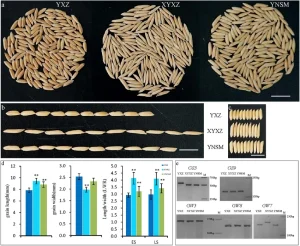
Rice grain length is a quantitative trait controlled by multiple genes and environmental factors. Because of this complex inheritance pattern, conventional breeding methods based only on visual selection are often inefficient and time-consuming. Modern breeding programs therefore rely on molecular markers and quantitative trait locus (QTL) analysis to identify genomic regions associated with desirable grain characteristics.
QTL mapping allows breeders to detect genes or chromosomal regions responsible for grain length variation. Marker-assisted selection (MAS) can then be used to rapidly select plants carrying favorable alleles during early breeding generations. Previous studies identified several rice grain length QTLs using populations such as F2, recombinant inbred lines (RILs), doubled haploids (DH), and backcross populations. However, many of these studies evaluated grain length in only one environment, making it difficult to determine whether the detected QTLs were stable under different environmental conditions.
QTL stability is a critical factor for successful marker-assisted breeding because unstable QTLs may show inconsistent effects across growing locations and seasons. Among previously identified grain-length QTLs, one major QTL located near the centromeric region of rice chromosome 3 consistently showed strong effects on grain length, explaining approximately 33% of phenotypic variation. Despite its importance, researchers still needed to determine whether this QTL represented a single major gene or multiple linked genes with smaller effects.
Importance of Fine Mapping in Rice Genetics
Fine mapping is necessary to precisely locate important QTLs within narrow genomic regions. This process improves understanding of gene function and facilitates map-based cloning of target genes. Traditional mapping populations such as F2, RIL, BC, and DH populations are not ideal for fine mapping because they contain large segregating chromosome segments from both parents.
To overcome this limitation, researchers use chromosome segment substitution lines (CSSLs) and near-isogenic lines (NILs). These populations contain only one or a few donor chromosome segments within the genetic background of the recurrent parent. This design minimizes interference from background genetic variation and allows more accurate identification of target QTL effects.
Secondary segregating populations derived from CSSLs or NILs are especially useful for:
- High-resolution QTL mapping
- Identification of stable agronomic genes
- Functional genomic studies
- Positional cloning of candidate genes
- Marker-assisted selection programs
Development of Rice Populations for QTL Analysis
Several rice populations were developed and analyzed to study grain length genetics:
- Recombinant inbred lines (RILs)
 derived from crosses between Asominori and IR24
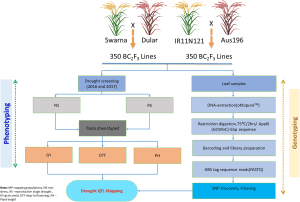
- Chromosome segment substitution lines (CSSLs) generated through repeated backcrossing
- BC4F2 and BC4F3 secondary populations for fine mapping
The CSSL populations were particularly valuable because they allowed researchers to isolate the effect of individual QTL regions within a nearly uniform genetic background.
Among several long-grain CSSLs, CSSL18 carrying the gl-3 allele was selected for advanced genetic analysis and fine mapping studies.
Multi-Environment Evaluation of Rice Grain Length
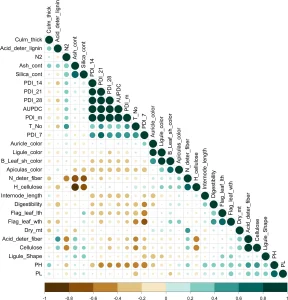
To evaluate QTL stability, experiments were conducted across ten different environments involving multiple geographic locations, cropping seasons, temperature conditions, and rainfall levels. These experiments included locations in China with diverse environmental conditions.
The study demonstrated that rice grain length showed continuous quantitative variation in the RIL population, confirming polygenic inheritance. Statistical analyses revealed:
- Significant genetic variation among rice lines
- Limited environmental influence on grain length
- Low genotype × environment interaction effects for major QTLs
- Stable expression of major grain-length loci across environments
These findings confirmed that some rice grain-length QTLs can maintain stable phenotypic effects under varying climatic conditions.
Identification of Major Grain Length QTLs
Six major QTLs associated with rice grain length were identified on multiple rice chromosomes. Among them, qGL-3a emerged as the most important and stable locus.
Key characteristics of qGL-3a included:
- Location in the centromeric region of chromosome 3
- Consistent detection across all tested environments
- High phenotypic variation explained (PVE)
- Positive effect on increasing grain length
- Strong genetic stability
The IR24 allele at qGL-3a increased rice grain length significantly compared with the Asominori allele. Unlike minor QTLs, qGL-3a showed very limited environmental sensitivity, making it highly suitable for marker-assisted breeding.
Epistatic Interactions and Environmental Effects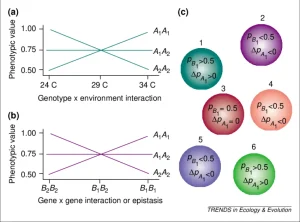
The study also identified several epistatic interactions between grain-length QTLs. Epistasis occurs when one gene influences the effect of another gene. Twelve pairs of epistatic QTLs were detected across multiple chromosomes.
These interactions demonstrated that:
- Some minor QTLs depend heavily on genetic background
- Environmental conditions influence epistatic expression
- Certain QTL effects may reverse under different genetic combinations
- Major QTLs like qGL-3a remain relatively stable despite epistasis
This highlights the complexity of quantitative trait inheritance in rice and explains why some minor QTLs are difficult to reproduce consistently across studies.
Fine Mapping of the gl-3 Gene
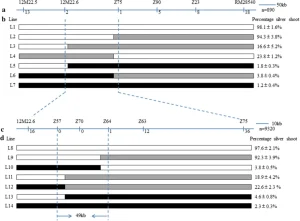
Advanced mapping analysis confirmed that qGL-3a behaved as a single Mendelian factor named gl-3. Segregation analysis in BC4F2 and BC4F3 populations demonstrated classic inheritance ratios consistent with single-gene control.
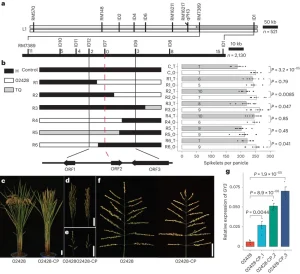
High-resolution mapping narrowed the gl-3 locus to a very small genomic interval of approximately 87.5 kb on chromosome 3. Several newly developed SSR markers were used to precisely define this region.
This achievement is highly significant because:
- Small genomic intervals facilitate candidate gene identification
- Fine mapping improves marker-assisted selection accuracy
- Closely linked markers reduce linkage drag during breeding
- Candidate genes can be cloned and functionally validated
Within the mapped interval, researchers identified multiple predicted genes, including proteins involved in kinase activity, transposase functions, and retrotransposon-related mechanisms. However, additional studies are required to determine the exact functional gene responsible for grain length regulation.
Relationship Between gl-3 and Rice Domestication
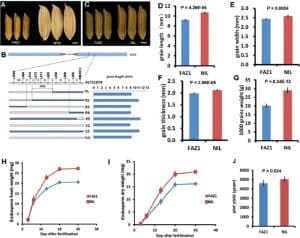
Interestingly, the gl-3 genomic region partially overlapped with another previously identified grain-weight QTL called gw3.1. Both loci were associated with seed size and domestication-related traits.
This suggests that grain length, grain weight, and seed shape may share common genetic pathways involved in rice domestication and crop evolution. Understanding these relationships could help breeders simultaneously improve multiple grain quality traits in elite rice cultivars.
Marker-Assisted Selection for Rice Quality Improvement
The stable expression and major phenotypic effect of qGL-3a make it an excellent candidate for marker-assisted selection (MAS). Several tightly linked SSR markers identified in this study can be directly used by rice breeders to introgress favorable alleles into commercial varieties.
Advantages of using the gl-3 locus in breeding programs include:
- Stable grain-length improvement across environments
- High heritability and strong phenotypic effects
- Reduced breeding time through molecular screening
- Improved rice appearance quality
- Better efficiency in pyramiding multiple quality-related QTLs
Marker-assisted QTL pyramiding may allow breeders to combine favorable genes for grain length, grain width, starch quality, and cooking characteristics into a single elite rice genotype.
Genetic Complexity of Rice Grain Traits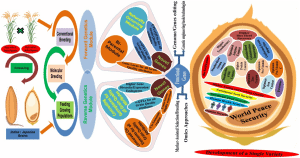
Although major QTLs such as qGL-3a are relatively stable, many minor QTLs display strong environmental and genetic background sensitivity. These minor loci often interact with modifying genes and may produce inconsistent phenotypic effects under different conditions.
This genetic complexity demonstrates that:
- Rice grain traits are controlled by complex regulatory networks
- Epistatic interactions play major roles in quantitative inheritance
- Minor QTLs may require specialized mapping populations for detection
- CSSLs are highly effective for isolating individual gene effects
Advanced genomic tools and larger mapping populations are therefore essential for dissecting the complete genetic architecture of rice quality traits.
Conclusion
QTL analysis and fine mapping studies have significantly improved understanding of rice grain length genetics. The identification of the stable major QTL qGL-3a and its conversion into the single Mendelian gene gl-3 represents an important advancement in rice molecular breeding.
This research demonstrated the value of:
- Multi-environment QTL evaluation
- CSSL and NIL populations
- High-resolution genetic mapping
- SSR marker development
- Marker-assisted selection strategies
The gl-3 locus and its associated molecular markers provide valuable genetic resources for improving rice grain appearance and quality. Future research involving candidate gene cloning, SNP analysis, and functional genomics will further clarify the biological mechanisms controlling rice grain development and domestication traits.