Introduction to Ethylene Signaling in Plants
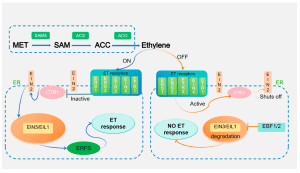
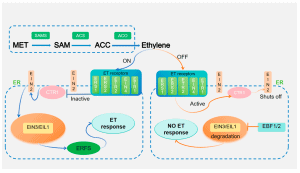
Ethylene is an important gaseous plant hormone involved in the regulation of plant growth, development, senescence, and responses to environmental stress. In the model plant Arabidopsis thaliana, extensive genetic studies using ethylene-response mutants have helped establish the ethylene signal transduction pathway. This signaling network includes ethylene receptors, CTR1 kinase, EIN2 membrane protein, EIN3 transcription factor, and several downstream regulatory components.
Researchers have identified five major ethylene receptor genes in Arabidopsis. These receptors are divided into two structural subfamilies. Subfamily I contains ETR1 and ERS1, while Subfamily II includes ETR2, EIN4, and ERS2. All receptor proteins are capable of binding ethylene molecules and transmitting hormonal signals that regulate physiological processes in plants.
The ETR1 receptor possesses histidine kinase activity, whereas several other ethylene receptors mainly display serine kinase activity. Functional studies demonstrated that the kinase domain of ETR1 contributes moderately to ethylene-response induction and seedling recovery after ethylene removal. Ethylene receptor signaling is also regulated by accessory proteins such as RTE1 and the copper transporter RAN1, which influence receptor stability and activity.
In addition, ETR1 and ERS1 can physically interact with CTR1 kinase, and this interaction may be modulated by protein phosphatase 2A. Homologs of Arabidopsis ethylene receptors have also been isolated in many crop plants, including tomato, tobacco, and rice, demonstrating the conserved nature of ethylene signaling mechanisms across higher plants.
Tobacco Ethylene Receptors NTHK1 and NTHK2
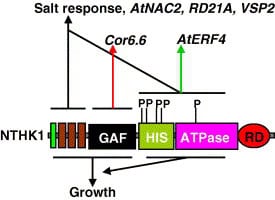
In tobacco plants, four ethylene receptor genes have been identified. Among them, NTHK1 and NTHK2 belong to the Subfamily II receptor group. These receptors contain several conserved structural domains, including hydrophobic transmembrane regions, a GAF domain, a divergent histidine kinase domain, and a receiver domain.
Biochemical analyses revealed distinct kinase activities for the two proteins. NTHK1 exhibits serine/threonine kinase activity, whereas NTHK2 displays both serine/threonine and histidine kinase activities depending on the ionic environment. Sequence comparisons further showed that NTHK1 and NTHK2 share approximately 50% identity with the Arabidopsis receptors EIN4 and ETR2.
Previous studies demonstrated that expression of both NTHK1 and NTHK2 increases in response to dehydration and mechanical wounding. Under salt-stress conditions, however, only NTHK1 expression was strongly induced, while NTHK2 remained relatively unchanged. This differential expression pattern suggested that NTHK1 may play a specialized role in plant salt-stress responses.
Role of Ethylene in Abiotic Stress Responses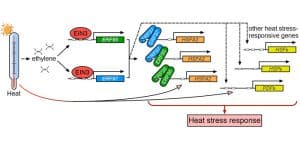
Ethylene has traditionally been considered a stress hormone because its production increases during exposure to environmental stresses such as drought, salinity, flooding, heat, and mechanical injury. Despite this, the precise role of ethylene signaling during abiotic stress adaptation has remained controversial.
To better understand this mechanism, researchers generated transgenic Arabidopsis plants overexpressing the tobacco ethylene receptor gene NTHK1. These genetically modified plants were then evaluated under salt-stress conditions to determine how altered ethylene signaling affects plant stress tolerance.
The study demonstrated that NTHK1 overexpression significantly increased plant sensitivity to salt stress and altered the expression of several salt-responsive genes. These findings highlighted the important role of ethylene receptor signaling in regulating plant adaptation to saline environments.
Phenotypic Characteristics of NTHK1-Overexpressing Plants
Transgenic Arabidopsis plants expressing the tobacco NTHK1 gene under the control of the constitutive 35S promoter displayed several developmental changes compared with wild-type plants.
Major Phenotypic Alterations
The majority of transgenic lines exhibited:
- Larger rosette leaves
- Delayed flowering
- Enlarged epidermal cells
- Longer hypocotyls in etiolated seedlings
- Reduced sensitivity to ethylene
The increased rosette size appeared to result primarily from cell enlargement rather than increased cell number. Flowering delay was associated with slower reproductive apex development.
Immunohistochemical analysis confirmed successful accumulation of the NTHK1 protein in young leaf tissues of transgenic plants.
Reduced Ethylene Sensitivity
Ethylene sensitivity was evaluated using ACC (1-aminocyclopropane-1-carboxylic acid), a precursor of ethylene biosynthesis. Normally, ethylene induces the classic “triple response” in dark-grown seedlings, characterized by:
- Shortened hypocotyls
- Thickened stems
- Exaggerated apical hooks
However, NTHK1-overexpressing seedlings showed weaker triple responses after ACC treatment compared with wild-type plants. Expression of the ethylene-inducible Chitinase B gene was also strongly reduced in transgenic plants.
These observations confirmed that NTHK1 overexpression decreases ethylene sensitivity, likely by enhancing receptor-mediated repression of ethylene signaling.
NTHK1 Enhances Salt Sensitivity in Plants
Salt-Stress Phenotypes
When exposed to sodium chloride (NaCl), NTHK1-transgenic plants developed severe salt-sensitive phenotypes.
At moderate salinity levels (50–100 mM NaCl), transgenic plants displayed:
- Pronounced leaf epinasty
- Compact rosette morphology
- Reduced leaf expansion
- Shortened petioles
At higher salt concentrations, overall growth inhibition became more severe than in wild-type plants.
These results demonstrated that enhanced ethylene receptor signaling increases plant susceptibility to salt stress.
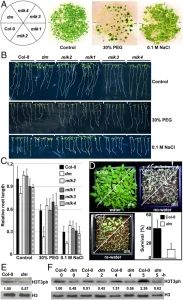
ACC Rescues Salt-Sensitive Phenotypes
Interestingly, application of ACC significantly reduced the salt-sensitive symptoms in NTHK1-overexpressing plants.
Plants transferred to media containing both NaCl and ACC rapidly recovered from epinasty and regained a morphology similar to wild-type plants. This rescue effect indicated that elevated ethylene production can suppress receptor-mediated salt sensitivity.
The findings strongly support the concept that active ethylene signaling contributes positively to plant salt tolerance.
Analysis of Ethylene-Signaling Mutants
To further investigate the pathway, several Arabidopsis ethylene-signaling mutants were tested under salt-stress conditions.
Gain-of-Function Mutants
The gain-of-function mutants:
- etr1-1
- ein4-1
displayed severe salt-sensitive phenotypes similar to NTHK1-overexpressing plants. These mutants also developed strong epinasty and reduced root growth under salt stress.
Because these mutant receptors are insensitive to ethylene binding, ACC treatment could not rescue the phenotype.
EIN2 and EIN3 Mutants
The ein2-1 mutant also exhibited strong salt sensitivity, indicating that EIN2 is essential for salt-tolerance signaling.
In contrast, the ein3-1 mutant did not show major epinastic changes, although it still displayed physiological stress damage. This suggests that salt-stress signaling may branch downstream of EIN2 and partially bypass EIN3.
Loss-of-Function Receptor Mutants
Loss-of-function receptor mutants such as:
- etr1-6
- etr1-8
- ein4-7
did not show enhanced salt tolerance. This suggests that disruption of a single receptor is insufficient to dramatically alter overall stress adaptation because multiple receptors likely function redundantly.
Electrolyte Leakage and Membrane Damage
Relative electrolyte leakage was used as an indicator of membrane damage caused by salt stress.
NTHK1-overexpressing plants showed significantly higher electrolyte leakage than wild-type plants under salt stress, indicating greater membrane injury and cellular instability.
Similarly, ethylene-insensitive mutants including etr1-1, ein4-1, and ein2-1 also displayed elevated leakage levels.
ACC treatment partially reduced electrolyte leakage in transgenic plants, further confirming that ethylene signaling contributes to membrane protection during salt stress.
Effects on Root Growth under Salinity
Salt stress strongly inhibited root growth in NTHK1-transgenic plants.
Compared with wild-type plants, transgenic seedlings developed significantly shorter roots under moderate salinity conditions. Similar root-growth inhibition was observed in etr1-1, ein4-1, and ein2-1 mutants.
However, loss-of-function receptor mutants and the ein3-1 mutant did not show major root-growth defects, supporting the idea that receptor signaling and EIN2 are major regulators of salt-induced root inhibition.
Regulation of Salt-Responsive Genes
NTHK1 signaling altered expression of several stress-related genes involved in transcriptional regulation and osmotic adaptation.
Upregulated Genes
The following genes were strongly induced in NTHK1-transgenic plants:
- AtERF4
- Cor6.6
- rd17
Among these, AtERF4 encodes an ethylene-responsive transcription factor associated with ethylene insensitivity and salt hypersensitivity.
Enhanced expression of these genes in receptor gain-of-function mutants suggests that excessive receptor signaling promotes stress-sensitive transcriptional programs.
Downregulated Genes
NTHK1 also suppressed expression of several protective stress-response genes, including:
- AtNAC2
- Lea genes
These genes normally contribute to osmotic protection and stress adaptation. Their reduced induction likely contributes to the increased salt sensitivity observed in transgenic plants.
Salt-Induced Accumulation of NTHK1 mRNA
An important observation from the study was that NTHK1 transcript accumulation increased specifically under sodium stress.
Interestingly:
- Na⁺ ions induced strong transcript accumulation
- Other ions such as K⁺ and Li⁺ had minimal effects
- ACC did not alter NTHK1 transcript levels
- Cycloheximide strongly enhanced transcript accumulation
These results suggest that NTHK1 expression is regulated post-transcriptionally and may involve RNA-stability mechanisms rather than transcriptional activation alone.
Proposed Model of Ethylene-Mediated Salt Responses
The study proposes a balance model between ethylene receptor signaling and ethylene hormone signaling.
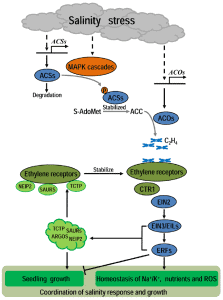
When Receptor Signaling Dominates
Plants exhibit:
- Reduced ethylene sensitivity
- Large rosettes
- Delayed flowering
- Increased salt sensitivity
When Ethylene Signaling Dominates
Plants exhibit:
- Enhanced salt tolerance
- Smaller rosettes
- Earlier flowering
- Improved stress adaptation
This dynamic balance likely allows plants to fine-tune growth and stress survival under changing environmental conditions.
Conclusion
This study demonstrates that the tobacco ethylene receptor homolog NTHK1 plays a major regulatory role in plant salt-stress responses. Overexpression of NTHK1 reduces ethylene sensitivity and increases susceptibility to salt stress by altering physiological responses, membrane stability, root growth, and stress-responsive gene expression.
The findings also reveal that ethylene signaling positively contributes to salt tolerance, while excessive receptor activity promotes stress sensitivity. ACC-mediated rescue experiments further confirm the antagonistic relationship between ethylene and its receptors.
Overall, the work provides important insights into the molecular mechanisms of ethylene-regulated stress adaptation and highlights the complex interaction between hormone signaling and environmental stress responses in plants.