Novel chemicals and invasive success
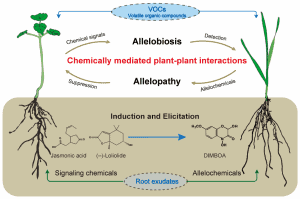
The “novel weapons hypothesis” (NWH) was originally proposed to explain why certain invasive plants, such as Centaurea diffusa and Centaurea maculosa, perform better in introduced ecosystems than in their native ranges. These species were observed to compete more effectively in North American grasslands than in Eurasian ecosystems, with evidence suggesting that chemical interactions (allelopathy) could be responsible.
According to the NWH, invasive plants may introduce unique biochemical compounds into new environments. Because native species in the invaded range have not evolved exposure to these chemicals, they may be more vulnerable to their effects. In this context, allelopathy refers to the inhibitory effect of plant-produced chemicals on the growth or survival of other plants.
The hypothesis was later expanded to include impacts not only on competing plants but also on herbivores, pathogens, and soil microorganisms. This broader view suggests that novel plant chemicals can influence multiple ecological interactions simultaneously.
A related evolutionary extension, the “allelopathic advantage against resident species” (AARS), proposes that invasive populations may evolve higher production of defensive or allelopathic chemicals in their introduced range. Under stronger selection pressure, invasive populations could become more chemically potent than their native counterparts.

Case studies: Centaurea species and allelochemicals
Centurea diffusa and Centaurea maculosa have spread extensively across North American ecosystems while remaining less common in their native Eurasian habitats. Research has focused heavily on their root exudates as potential drivers of invasion success.
Both species release biologically active compounds from their roots, including 8-hydroxyquinoline (C. diffusa) and catechin (C. maculosa). Experiments have shown that these plants suppress the growth of neighboring grasses more strongly in introduced ranges than in native ones.
One key experimental approach used activated carbon, which binds and neutralizes chemical compounds in soil. When activated carbon reduced the negative effects of C. diffusa, it supported the idea that chemical inhibition plays a role in its competitive ability.
Similarly, studies on C. maculosa suggested that catechin may suppress germination and growth of native plant species. Early reports also indicated that invaded soils contained higher catechin concentrations than soils in the plant’s native range, reinforcing the idea of chemically driven invasion.
Challenges and conflicting evidence
More recent research has questioned the strength and consistency of these findings. Some studies have failed to replicate high catechin concentrations in invaded soils or strong phytotoxic effects at ecologically realistic doses.
Field measurements have shown that catechin levels can vary widely depending on season, location, soil conditions, and sampling methods. In some cases, no detectable catechin was found, while in others levels matched earlier reports. This suggests that production and persistence of allelochemicals are highly dynamic rather than constant.
These inconsistencies highlight the importance of experimental design, including soil handling, extraction methods, and environmental context. They also suggest that conclusions based solely on laboratory conditions may not fully represent field reality.
Complexity of root exudates and soil interactions
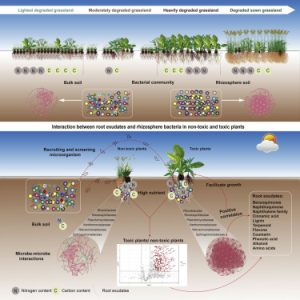
Plant root exudation is now understood as a complex mixture of chemicals rather than a single active compound. Alongside allelochemicals like catechin, plants release sugars, proteins, organic acids, and other metabolites that influence soil chemistry and microbial communities.
These compounds do not act independently. Instead, they interact in ways that can enhance or reduce biological activity. For example, one compound may promote microbial growth while another inhibits it, creating a combined ecological effect that differs from individual compound behavior.
Root exudation is also influenced by environmental conditions, developmental stage, and neighboring organisms. Some studies suggest that neighboring plants or soil microbes can alter the quantity and composition of exuded chemicals, indicating a dynamic chemical communication system in the rhizosphere.
Soil microbes and ecological feedback
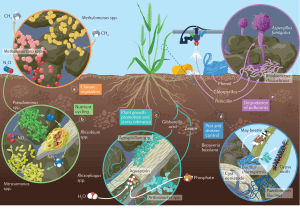
Soil microorganisms play a major role in shaping invasion outcomes. In native ranges, soil biota may suppress invasive plants, while in introduced ranges, microbial communities may instead support their growth.
Certain microbes are even capable of degrading allelochemicals, potentially reducing their effectiveness over time. Conversely, other microbial interactions may enhance chemical release or modify plant metabolism, further complicating the ecological outcome.
These feedback loops suggest that plant invasion success cannot be explained by plant chemistry alone but must include microbial ecology and environmental context.
Evolutionary perspectives
From an evolutionary standpoint, the NWH assumes that chemical traits providing competitive advantages are favored by natural selection. If a compound is more beneficial in an invaded environment than in the native range, selection may favor increased production of that compound.
However, determining whether allelochemicals are truly “novel” is extremely complex. Many plant chemicals may already exist in other species or ecosystems, meaning that adaptation may occur through modification of existing biochemical pathways rather than the evolution of entirely new compounds.
Evidence also suggests that native species in invaded regions may gradually evolve tolerance to allelochemicals, reducing their long-term effectiveness. This implies that chemical-mediated invasion is not static but evolves over time.
Whole-plant biochemical perspective
Invasion success is not driven solely by root exudates. Leaves, stems, and decomposing plant material also release biologically active compounds into the environment. Volatile chemicals and rain-leached metabolites can further influence surrounding organisms.
Plant chemistry also interacts with herbivores. For example, herbivore damage can alter chemical production in roots and shoots, sometimes increasing allelochemical release. This creates a complex network where biotic stress influences chemical ecology both above and below ground.
These interactions show that plant invasion is shaped by integrated biochemical responses rather than isolated compounds.
Conclusion and future directions
Overall, plant biochemistry provides important insights into invasion ecology, but it cannot be viewed as a single controlling factor. Allelopathy interacts with microbial ecology, environmental variation, evolutionary adaptation, and plant physiology.
Future research should focus on real-world field conditions, multi-species interactions, and integrated chemical profiling of plant exudates. Advances in molecular biology and genomics may also help identify the genetic basis of allelochemical production and regulation.
A more complete understanding of plant invasions will require combining ecological, biochemical, and evolutionary perspectives to explain how plants succeed in new environments and how their chemical interactions shape ecosystems over time.