Introduction to miRNAs in Modern Crop Improvement

Rapid population growth, industrial expansion, and climate change are placing enormous pressure on global agricultural systems. Environmental instability now threatens crop productivity, food quality, and long-term food security worldwide. Modern crops are continuously exposed to severe environmental stresses during their growth cycle, including both abiotic and biotic stress factors.
Abiotic stresses include drought, salinity, nutrient imbalance, heavy metal toxicity, flooding, hypoxia, extreme temperatures, and ultraviolet radiation. At the same time, plants must defend themselves against biotic stresses such as bacterial infections, fungal diseases, viruses, insect pests, and nematodes. These environmental constraints negatively affect plant growth, metabolism, physiological balance, cellular signaling, and yield performance.
Traditional crop breeding approaches often struggle to improve one important agronomic trait without negatively affecting another. For example, enhancing stress tolerance may reduce productivity, growth rate, or crop quality. Because of this limitation, researchers are increasingly focusing on regulatory genes capable of controlling multiple biological pathways simultaneously with high precision.
Recent advances in plant genomics, next-generation sequencing technologies, transcriptomics, and molecular biotechnology have enabled scientists to identify numerous genes associated with stress adaptation and plant development. However, understanding how these genes are regulated remained a major challenge. This led to the discovery of microRNAs (miRNAs), a class of small non-coding RNA molecules that function as critical regulators of gene expression in plants.
Plant miRNAs regulate gene activity mainly at the post-transcriptional level by targeting messenger RNAs (mRNAs). Even though miRNAs represent only a small fraction of the plant genome, they regulate many important transcription factors and stress-responsive genes involved in growth, development, metabolism, and environmental adaptation.
Today, miRNAs are recognized as master regulators in plants because they influence a wide range of biological processes, including:
- Plant growth and organ formation
- Root and shoot architecture
- Flowering and fruit development
- Nutrient homeostasis
- Hormonal signaling pathways
- Abiotic stress tolerance
- Disease resistance
- Senescence and aging processes
Because of their broad regulatory capacity, miRNAs are becoming powerful molecular tools for crop improvement and climate-smart agriculture.
miRNA Biogenesis and Mechanism of Action in Plants
What Are Plant miRNAs?
MicroRNAs are short non-coding RNA molecules that control gene expression through sequence-specific interactions with target mRNAs. These molecules act as post-transcriptional regulators capable of activating or suppressing critical cellular pathways.
Plant miRNAs regulate numerous physiological and developmental activities by controlling transcription factors, signaling proteins, and stress-responsive genes. Environmental conditions strongly influence miRNA production, allowing plants to rapidly adapt to changing surroundings.
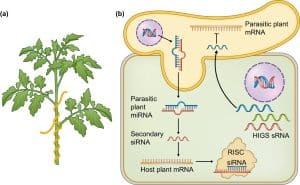
miRNA Biosynthesis Pathway
In plants, miRNA genes, known as MIR genes, are generally located in intergenic regions of the genome. These genes are transcribed by RNA polymerase II to produce primary miRNA transcripts called pri-miRNAs.
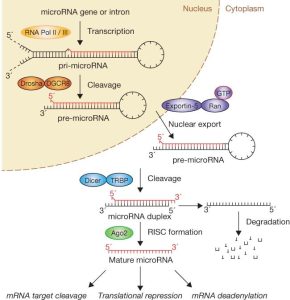
The miRNA maturation process involves several highly coordinated steps:
1. Formation of Primary miRNA (pri-miRNA)
The MIR gene is first transcribed into a long pri-miRNA molecule containing characteristic stem-loop structures.
2. Processing by DCL1 Enzyme
The RNase III enzyme DICER-LIKE1 (DCL1) cleaves the pri-miRNA into shorter precursor structures. Depending on precursor size and structure, cleavage may occur from the base-to-loop direction or vice versa.
3. Formation of miRNA/miRNA* Duplex
Further processing generates a double-stranded miRNA duplex consisting of:
- Mature miRNA strand
- Complementary miRNA* strand
This duplex is stabilized through methylation by HUA ENHANCER1 (HEN1).
4. Export to Cytoplasm
The stabilized duplex is transported from the nucleus to the cytoplasm through export proteins such as HASTY and EXPO1.
5. RISC Complex Assembly
The active mature miRNA strand is incorporated into the ARGONAUTE1 (AGO1) protein to form the RNA-Induced Silencing Complex (RISC), which performs gene silencing activities.
Mechanisms of miRNA-Mediated Gene Regulation
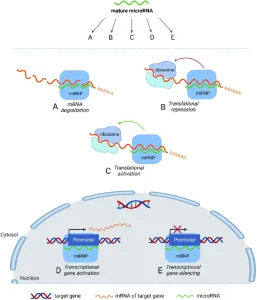
Plant miRNAs regulate target genes mainly through two molecular mechanisms:
1. mRNA Cleavage
In plants, miRNAs usually show near-perfect complementarity with their target mRNAs. This enables AGO proteins within the RISC complex to cleave the target transcript directly.
Following cleavage:
- Target mRNAs are degraded
- Protein synthesis is stopped
- Gene expression is suppressed
This mechanism is considered the dominant mode of action in plants.
2. Translational Repression
Some plant miRNAs inhibit translation without degrading the target mRNA. In this process:
- Ribosome activity is blocked
- Translation initiation is inhibited
- Protein synthesis efficiency decreases
This mechanism is especially important in developmental regulation and stress adaptation.
Role of miRNAs in Plant Growth and Development
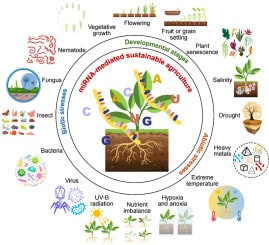
Regulation of Vegetative Growth
Plant miRNAs regulate almost every stage of vegetative growth and morphogenesis. They influence:
- Cell differentiation
- Embryo formation
- Seed development
- Root architecture
- Leaf formation
- Meristem activity
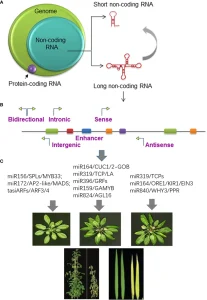
Several miRNAs such as miR156, miR160, miR164, miR165/166, and miR390 play major roles in developmental regulation.
miRNAs in Root Development
Root systems are essential for water uptake, nutrient acquisition, and stress adaptation. Multiple miRNAs regulate root growth through auxin-responsive signaling pathways.
Important root-regulating miRNAs include:
- miR160
- miR164
- miR167
- miR390
These miRNAs target Auxin Response Factor (ARF) genes that control:
- Root elongation
- Root cap formation
- Lateral root development
- Adventitious root formation
Research in crops such as peanut, grapevine, apple, sweet potato, and rice has demonstrated the importance of miRNA-mediated root architecture modification.
Shoot and Leaf Development
miRNAs also regulate shoot apical meristem activity and leaf morphogenesis.
Key miRNAs involved include:
- miR165/166
- miR319
- miR394
These miRNAs influence:
- Leaf size and curvature
- Plant height
- Shoot branching
- Meristem differentiation
- Secondary metabolite production
For example, miR319 regulates leaf morphology and plant architecture in tomato, rapeseed, and Arabidopsis.
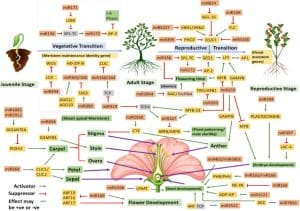
miRNAs in Flowering and Reproductive Development
Flowering transition is controlled by a complex interaction between hormones, age signals, and environmental factors. Two major miRNAs control flowering timing:
- miR156
- miR172
Typically:
- miR156 levels decrease before flowering
- miR172 expression increases during reproductive transition
These miRNAs regulate important transcription factors responsible for:
- Floral induction
- Inflorescence architecture
- Pollen development
- Fruit setting
- Seed production
Several studies have demonstrated that manipulating miRNA expression can delay or accelerate flowering and improve reproductive efficiency in crops.
miRNAs in Plant Senescence
Senescence represents the final developmental stage in plants and involves highly regulated molecular changes.
Various miRNAs participate in:
- Leaf aging
- Chlorophyll degradation
- Hormonal signaling
- Nutrient remobilization
- Oxidative stress control
miRNAs such as:
- miR166
- miR164
- miR156
- miR393
- miR396
have been linked to senescence regulation in rice, tomato, apple, and Arabidopsis.
miRNAs and Abiotic Stress Tolerance
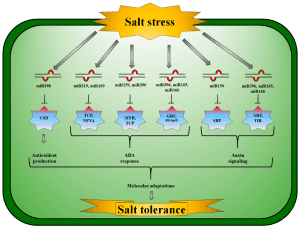
miRNAs in Salinity Stress Tolerance
Soil salinity is a major global agricultural problem that severely limits crop productivity.
Several miRNAs improve salt tolerance by regulating:
- Ion homeostasis
- Reactive oxygen species scavenging
- Ethylene signaling
- Root development
- Osmotic adjustment
Important salinity-responsive miRNAs include:
- miR396
- miR393
- miR156
- miR319
- miR164
- miR167
- miR535
These miRNAs have been studied extensively in rice, tomato, maize, tobacco, sesame, melon, and creeping bentgrass.
miRNAs in Drought Stress Adaptation
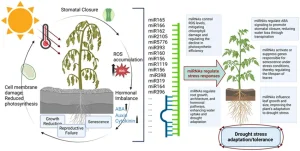
Drought is one of the most damaging abiotic stresses affecting global food production.
miRNAs regulate drought tolerance through:
- ABA signaling pathways
- Root architecture modification
- Stomatal regulation
- Osmotic balance
- Antioxidant defense systems
Major drought-responsive miRNAs include:
- miR393
- miR156
- miR159
- miR166
- miR171
- miR169
These miRNAs help plants maintain water balance, reduce oxidative damage, and improve survival under water-deficit conditions.
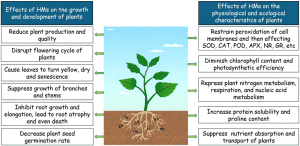
Heavy Metal Stress Response
Heavy metal contamination from industrial and agricultural activities threatens food safety worldwide.
miRNAs regulate tolerance against:
- Cadmium (Cd)
- Arsenic (As)
- Mercury (Hg)
- Aluminum (Al)
- Nickel (Ni)
Stress-responsive miRNAs involved include:
- miR159
- miR164
- miR166
- miR390
- miR393
- miR398
These miRNAs control metal transporters, detoxification enzymes, antioxidant systems, and transcription factors.
Temperature Stress Regulation
Extreme heat and cold negatively affect plant metabolism, growth, and reproduction.
Temperature-responsive miRNAs regulate:
- Heat shock proteins
- ROS detoxification
- Hormonal signaling
- Protein folding
- Stress signaling pathways
Temperature-regulated miRNAs include:
- miR156
- miR159
- miR319
- miR393
- miR535
Research in rice, banana, sweet potato, wheat, maize, and tomato confirms the major role of miRNAs in thermotolerance and chilling tolerance.
miRNAs Under Hypoxia and Flooding Stress
Flooding and oxygen deficiency severely disrupt plant respiration and metabolism.
Under hypoxia and submergence conditions, miRNAs regulate:
- Redox homeostasis
- Hormone signaling
- Root growth adaptation
- Energy metabolism
- Stress-responsive gene networks
Important hypoxia-responsive miRNAs include:
- miR159
- miR166
- miR167
- miR169
- miR393
These molecules help plants survive transient oxygen deprivation and waterlogging conditions.
Future Potential of miRNA Engineering in Agriculture
Modern biotechnology now allows precise engineering of miRNAs and their target genes for crop improvement.
Potential applications include:
- Development of climate-resilient crops
- Enhanced stress tolerance
- Improved nutrient efficiency
- Better yield stability
- Disease-resistant cultivars
- Improved plant architecture
- Enhanced fruit and grain quality
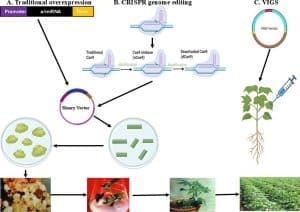
Advanced tools such as:
- CRISPR/Cas genome editing
- RNA interference technologies
- Artificial miRNAs
- Next-generation sequencing
- Functional genomics
are accelerating miRNA-based crop breeding programs.
Conclusion
MicroRNAs have emerged as powerful molecular regulators in plant biology and modern agricultural biotechnology. These small non-coding RNAs control critical developmental pathways, environmental stress responses, hormone signaling networks, and metabolic activities.
Because miRNAs regulate multiple target genes simultaneously, they provide enormous potential for engineering high-yielding, stress-tolerant, and climate-smart crops. Future advances in genomics, gene editing, and molecular breeding are expected to make miRNA-based crop improvement one of the most promising strategies for sustainable agriculture and global food security.