Introduction to Wild Mulberry Genetic Resources
The improvement of mulberry (Morus spp.) remains a major objective in modern sericulture and mulberry breeding programs. Researchers focus on enhancing both the quantitative and qualitative characteristics of mulberry foliage because leaf quality directly influences silkworm growth, cocoon production, and silk yield. Successful genetic improvement of mulberry largely depends on the availability of diverse germplasm resources containing valuable hereditary traits.
In India, four major mulberry species are naturally distributed: Morus indica, Morus alba, Morus laevigata, and Morus serrata. These species represent an important genetic reservoir for future mulberry breeding and crop improvement programs. Early mulberry breeding efforts in India mainly focused on cultivated species and first-generation hybrids, which gradually narrowed the genetic base of commercially cultivated mulberry varieties.
Since the 1960s, several Indian research institutes working under the Central Silk Board have developed improved mulberry varieties through conventional breeding, polyploid breeding, mutation breeding, and backcross hybridization. High-yielding varieties such as S1, S1635, S799, C776, BC259, and V-1 were released for commercial sericulture cultivation. Among these, the V-1 variety demonstrated exceptional productivity with leaf yields reaching nearly 70 metric tons per hectare annually along with superior nutritional quality for silkworm feeding.
Although substantial progress has been achieved using cultivated germplasm, excessive reliance on related parental lines has reduced genetic diversity within breeding populations. This narrow genetic base may limit the long-term adaptability of mulberry varieties to changing environmental conditions, diseases, pests, drought stress, and frost damage. Therefore, introducing exotic and wild mulberry species into breeding programs has become increasingly important for sustainable mulberry improvement.
Biodiversity of Wild Mulberry Species
Wild mulberry species exhibit remarkable biodiversity across different agroclimatic regions of India. Morus serrata, commonly known as Himalayan mulberry, is primarily distributed in the northwestern Himalayan regions. This species displays extensive morphological variation in bark color, leaf structure, phyllotaxy, internodal length, and surface texture. Leaves may range from unlobed to multilobed forms and often possess rough, hairy, or velvety textures that help the plant tolerate harsh environmental conditions such as cold temperatures and drought stress.
Similarly, Morus laevigata demonstrates unique botanical characteristics including large unlobed leaves, elongated internodes, and distinctive phyllotaxy. The species is naturally adapted to higher altitude ecosystems and exhibits strong resistance to abiotic stresses such as drought, salinity, and frost.
The genetic diversity observed among these wild mulberry populations provides valuable opportunities for breeders to identify stress-tolerant genotypes and incorporate adaptive traits into cultivated varieties.
Ploidy Variation and Chromosomal Diversity
Mulberry species possess considerable variation in chromosome number and ploidy level, making them highly important genetic resources for breeding research. Most cultivated mulberry genotypes are diploid with chromosome numbers of 2n = 28. However, naturally occurring polyploid forms including triploid, tetraploid, hexaploid, and even docosaploid genotypes have been identified in several wild species.
Morus nigra and Morus serrata exhibit particularly high chromosomal diversity. Polyploidy influences several agronomic traits such as leaf texture, growth rate, moisture retention, pollen size, and adaptability to environmental stress.
Higher ploidy levels are often associated with coarse leaves, lower palatability, slower growth, and reduced suitability for silkworm feeding. However, polyploid wild species remain valuable for breeding because they contribute stress-resistance genes and broaden the overall genetic base of mulberry germplasm collections.
Researchers also utilize chloroplast number, stomatal frequency, and pollen morphology as indirect indicators for determining ploidy levels and grouping mulberry accessions during genetic evaluation programs.
Reproductive and Morphological Variability
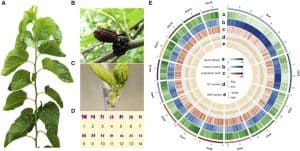
Wild mulberry species exhibit significant reproductive diversity. In Morus serrata, male and female flowers occur on separate plants, indicating a dioecious reproductive system. Inflorescence length, pollen size, pollen pore number, and fruit color vary considerably depending on genotype and ploidy level.
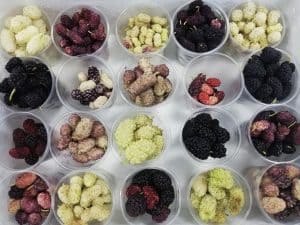
As chromosome numbers increase, pollen grain diameter also increases. Fruit color ranges from black and pink to cream-colored forms, while mature fruits are generally sweet and rich in mucilage.
Morus laevigata also demonstrates dioecious flowering behavior with long inflorescences and elongated sweet fruits that are frequently seedless. High pollen viability and reproductive variability make these species useful for hybridization and introgression breeding programs.
Leaf Anatomy and Histological Characteristics
Leaf anatomical traits play a critical role in mulberry adaptation and silkworm nutrition. Wild species show considerable variation in stomatal density, idioblast frequency, palisade tissue thickness, and leaf moisture retention capacity.
The thick, hairy leaves of Morus serrata contribute to drought tolerance and environmental resilience. Increased palisade and spongy tissue thickness improve water retention during adverse climatic conditions. These structural adaptations help the species survive under cold and dry Himalayan environments.
In Morus laevigata, anatomical variability includes differences in stomatal size, leaf thickness, and chloroplast distribution. Such traits are highly important for identifying superior genotypes suitable for stress-resistant breeding programs.
Growth Performance and Agronomic Traits
Wild mulberry accessions exhibit substantial variation in growth performance and biomass production. Traits such as shoot length, leaf weight, internodal distance, moisture content, and moisture retention differ significantly among genotypes.
Morus serrata demonstrates excellent moisture retention and drought adaptation, while Morus laevigata produces large leaves with high biomass accumulation.
The wide phenotypic variability observed in these wild populations indicates strong environmental adaptability and provides useful material for crop improvement under diverse agroclimatic conditions.
Genetic Diversity and Molecular Variability
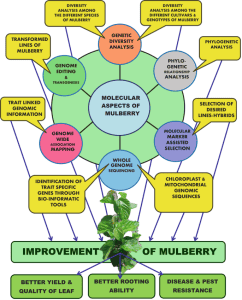
Genetic diversity analysis conducted using morphological traits, anatomical characteristics, reproductive parameters, and DNA markers has revealed substantial interspecific and intraspecific variation among mulberry species.
Among all studied species, Morus serrata exhibited the highest genetic diversity, making it one of the most valuable resources for future breeding programs. ISSR marker studies demonstrated high levels of DNA polymorphism among wild populations, confirming the presence of broad genetic variability.
This diversity is particularly valuable for introgression breeding aimed at transferring resistance genes for drought tolerance, frost resistance, disease resistance, and environmental adaptability into cultivated mulberry varieties.
Breeding Potential of Wild Mulberry Species
The primary objective of mulberry breeding is to develop high-yielding varieties with broad environmental adaptability and improved leaf quality. Wild species provide an important source of novel genes capable of strengthening the genetic base of commercial cultivars.
Morus serrata possesses several desirable agronomic traits including:
- High leaf moisture content
- Improved moisture retention
- Drought resistance
- Frost tolerance
- Disease resistance
Similarly, Morus laevigata contributes:
- Large leaf size
- Increased leaf thickness
- Salinity tolerance
- Abiotic stress resistance
Inter-specific hybridization involving wild and cultivated mulberry species has shown promising results. F1 hybrids frequently display vigorous growth, improved biomass production, and enhanced stress tolerance while maintaining acceptable silkworm feeding quality.
Although incompatibility caused by chromosome variation and ploidy differences can reduce seed set and hybrid viability, continued introgression breeding and backcrossing strategies may help overcome these limitations.
Propagation Challenges of Wild Species
Vegetative propagation of wild mulberry species remains difficult because many accessions show poor rooting ability. Grafting has emerged as an alternative propagation method for conserving and multiplying valuable germplasm.
However, graft incompatibility frequently occurs due to differences in chromosome number and tissue compatibility between rootstock and scion material. Despite these challenges, successful grafting techniques are essential for preserving rare wild genotypes and supporting future breeding research.
Importance in Sericulture and Silkworm Feeding
Wild mulberry species have demonstrated potential utility in silkworm rearing. Bioassay studies indicate that leaves of Morus serrata can support productive silkworm growth, especially during late larval stages. Mature trees are capable of producing large quantities of foliage suitable for supplemental feeding.
Similarly, feeding trials involving Morus laevigata showed encouraging cocoon yield, larval weight, and silk production performance. Although leaf texture may initially appear coarse, hybrid progenies often inherit softer and more palatable foliage characteristics.
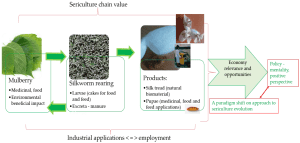
These findings highlight the possibility of integrating wild mulberry germplasm into commercial sericulture systems while simultaneously improving stress tolerance and biomass productivity.
Utilization of Wild Genetic Resources in Future Breeding
Wild mulberry species remain underutilized despite their enormous genetic potential. Expanding the genetic base of cultivated mulberry is essential to prevent genetic erosion and improve resilience against climate stress and emerging diseases.
The integration of wild germplasm into breeding programs through interspecific hybridization, introgression breeding, molecular characterization, and genetic conservation strategies will play a major role in future mulberry improvement.
Comprehensive characterization of wild populations is necessary for identifying elite accessions with valuable agronomic traits. Conservation and systematic utilization of these genetic resources will support the development of next-generation mulberry varieties suitable for sustainable sericulture and changing environmental conditions.
Overall, wild mulberry species such as Morus serrata and Morus laevigata represent highly valuable reservoirs of genetic diversity that can significantly contribute to long-term mulberry crop improvement, stress resistance breeding, and sericulture sustainability.